
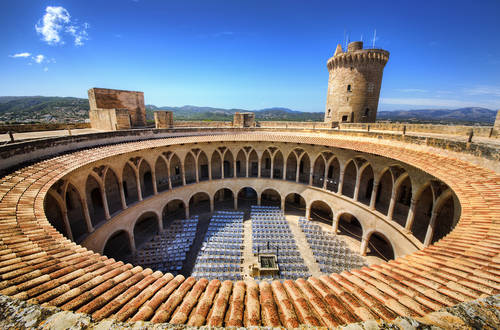
Besides sun, beach, and sea, the Balearic island of Mallorca also has many castles, fortresses and ruins to offer. Marcel Remus presents the most worth-seeing structures.
Old walls, such as castles, fortresses, and ruins, often hold a special fascination. They possess a mysterious, almost mystical aura.Qualities that many don't immediately associate with Mallorca. However, in addition to sun, beach, and sea, the Balearic island has some old walls to offer that are well worth a visit.
As early as the Middle Ages, before the Arabs arrived on the island, the first castles were built in Mallorca. They mostly served the Pirate attack defence.Gradually, more and more fortifications were built to protect the islanders from unwelcome guests. Some of the numerous castles, palaces and fortresses, mostly built between the 13th and 18th centuries, have since fallen into ruin. However, they have not lost their special charm. Marcel Remus presents you with the most worthwhile castles, fortresses and ruins on the popular Balearic island.
Bellver Castle
The Castell de Bellver, erected in the 14th century, is located approximately 3 km west of Palma de Mallorca on a hill, 112.6 m above sea level. It was built Spain's only round castle between 1300 and 1311. The client was King James II. The castle served for a long time as the residence of the Kings of Mallorca, however, a feared prison was also located in the building's cellar.
The structure, which is one of the most beautiful castles in Mallorca, stands in the middle of a densely wooded area and is clearly distinguished by its 33 m high keep. For better defence, it is surrounded by a wide moat, so that the castle grounds are entered via a drawbridge. Due to its elevated position, the castle offers breathtaking view of the Harbour as well as the city centre of Palma. This is how the round castle incidentally got its name (Bellver = beautiful view).
Today the castle is owned by the city of Palma and houses the Historical Museum of Urban Development of Palma.Furthermore, sculptures by the Mallorcan artist Antoni Despuig and Jovellanos's room can also be visited. The castle can be reached via Carrer de Bellver.
Capdepera Castle
One of the largest fortifications on the island is Capdepera Castle. It is located on the Puig de Capdepera hill in the town of the same name, at an altitude of 159m in the west of the island. Until the 18th century, it was used to defend against pirate attacks. At this time, almost all citizens of the town lived within the fortress walls that surround the castle. Today, the structure has been restored and is considered The city's most important sight.
The Chapel of Nuestra Senyora de la Esperanza forms the highest point of the castle complex. It houses a statue of the Virgin Mary, which was meant to protect the inhabitants from pirates. Additionally, there is a viewpoint on the chapel's roof, offering a impressive view to the neighbouring island of Menorca also offers. This castle also houses a museum today – in this case, dedicated to the town history of Capdepera. The topic of basket weaving is covered in particular detail, as it formed the most important economic sector in earlier years.
Alaró Castle
In the municipality Alaró, Below the mountain peak of Puig d’Alaró, the Castell d’Alaró castle ruins stand at almost 820 m above sea level. Due to the considerable height, the ruins offer a fabulous view all the way to Palma. The former fortress served as a resistance against the conquest by the Saracens. When exactly it was built is not known, however, the oldest discovered documents date back to the year 902. Since 1932, the ruins have been Spanish cultural monument marked. The ownership rights are shared by the municipality of Alaró, the Diocese of Mallorca, and a private owner.
The Castell d'Alaró can be reached, for example, via a A variety of hiking trails.Those with plenty of time and good stamina can try the large circular route, which starts at Placa de l’Ajuntament. This route takes approximately five hours, covers around 750 metres of elevation gain, and offers dreamlike views of the surrounding mountain landscape. Those who prefer a more relaxed pace can park their car at the Es Pouet car park and reach the ruin via a staircase within 15 minutes.
Furthermore, the Castell d’Alaró can be reached on the Sunday after Easter and on 8 September (the feast of the Nativity of the Virgin Mary). Pilgrimages undertaken. If you wish to visit the ruins in peace, you should consider this.
Image above: ©Shutterstock Inc./Rolf E. Staerk
 German
  English
  Spanish