
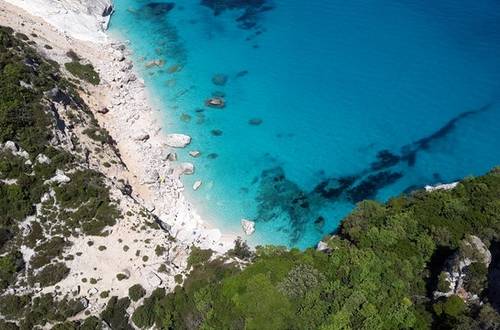
Cala Murta, translated as „Myrtle Cove“, is located on the Mallorcan peninsula of Formentor on the coast of Manacor, the third-largest municipality on the Spanish Balearic Island. It is a particularly idyllic spot on the Mediterranean Sea near the popular holiday resort of Porto Cristo, south of the settlement of Sa Torre.
On the northwest side of Cala Murta lies a picturesque pebble beach, about ten metres long and twelve metres wide, which occasionally has seaweed deposited on it. Among the gravel are colourful stones, which form a vibrant contrast to the green of the aquatic plant. A stream, about 400 metres long and coming from the west, also flows in here, only carrying water after heavy rainfall. On the north side, a machine gun post was built in the second half of the 1930s during the Spanish Civil War, which still exists today. The „Myrtle Bay“ is framed by steep cliffs and flat rocks, on which gnarled bushes and fragrant pines grow.
The entrance to the Caves of Drac
To the north of Cala Murta lies the Caves of Drac (Dragon Caves). This is a tropfstein cave system that has been developed for tourism. The inhabitants of this Balearic island already knew about it 3,000 years ago and even settled close to it. The entrance to the underground grotto was discovered during excavations for prehistoric finds. The passages beneath the surface extend for a total length of 1.7 kilometres, along which there are Europe's largest underground lake and six other smaller bodies of water.
According to legend, a dragon once guarded the Coves del Drac a valuable Templar treasure,however, dragged him deeper and deeper into the cave, so nobody dared to retrieve the treasures any further. Both the indigenous people of Mallorca and numerous pirates only ever ventured about 200 metres in before turning back for fear of the darkness. After the suppression of the Knights Templar in 1339, a group of soldiers was commissioned by order of the Mallorcan governor to search for the lost treasure – it was on this expedition that the first orientation maps were created, which are kept in the local archives of the Balearic island. According to other sources, the underground passages got their name from the stalagmites and stalactites that jut out from the floor and ceiling like dragon's teeth.
The Spanish pioneer Juan Servera Camps, who explored the immense grotto and later opened it to the public, relocated its new entrance to Cala Murta in 1929, where it has served as the main entrance ever since. He also had stairs and seating areas created within the grotto. The enthusiastic explorer began hosting private performances with music and ballet in the caves from 1934 onwards, sending his guests on the lake in orchestra boats and arranging for the complete illumination of the passages. The official opening of the Coves del Drac took place in 1935, with its chambers receiving fanciful names such as „Diana's Bath,“ „Monk and Cactus,“ or „Fairy Theatre.“ To this day, visitors are taken musical sounds guided through the cave system.
Swimming in Cala Murta
very quiet. Quiet and peaceful.Due to the 180-metre deep sea cut and its semi-circular shape, „Myrtenbucht“ is beautifully sheltered. Even when the wind blows across Mallorca, hardly anything is felt in Cala Murta, and there is also usually little swell. The Mediterranean water here is crystal clear, making it not only ideal for swimming but also particularly well-suited for snorkelling and diving. As both the beach and the ocean floor are rocky, light summer shoes with sturdy soles are recommended for your stay in this romantic bay.
Anyone wishing to visit Cala Murta on their holiday in Mallorca can get there by car via the road from Port de Pollença to Cap Formentor. From the car park near the bay, a footpath of about 1.7 kilometres leads to the beach.
Cover image: Copyright @ pixabay/Simon
 German
  English
  Spanish